Resurface Concrete Driveway NZ: Resurfacing, Repair, or Replacement
An ageing or damaged concrete driveway doesn't always mean starting from scratch, but knowing which option makes sense — resurfacing, repair, or full replacement — can save you significant time and money. Across New Zealand, concrete driveways are exposed to constant weathering, ground movement, and vehicle loading, which over time can lead to cracking, surface wear, discolouration, or uneven settling, particularly on properties with variable soil conditions like those common in Canterbury.
Resurfacing is often the most cost-effective option when the underlying slab is structurally sound but the surface has worn or faded, giving your driveway a fresh finish without a full rebuild. Repair suits driveways with isolated issues, such as minor cracking or small areas of damage, where the rest of the slab remains in good condition. Replacement becomes necessary when structural problems, extensive cracking, or foundation movement mean the existing slab can no longer be reliably restored. Choosing the right approach depends on the extent and cause of the damage, so a proper assessment is the first step before deciding how to move forward. Below, we look at each option in more detail to help you determine the best fit for your driveway.
What Does It Mean to Resurface a Concrete Driveway?
Concrete resurfacing involves applying a new layer of material — usually a concrete overlay or resurfacing compound — over your existing driveway. It's a way to restore the appearance and extend the life of a driveway without the cost and disruption of a full replacement.
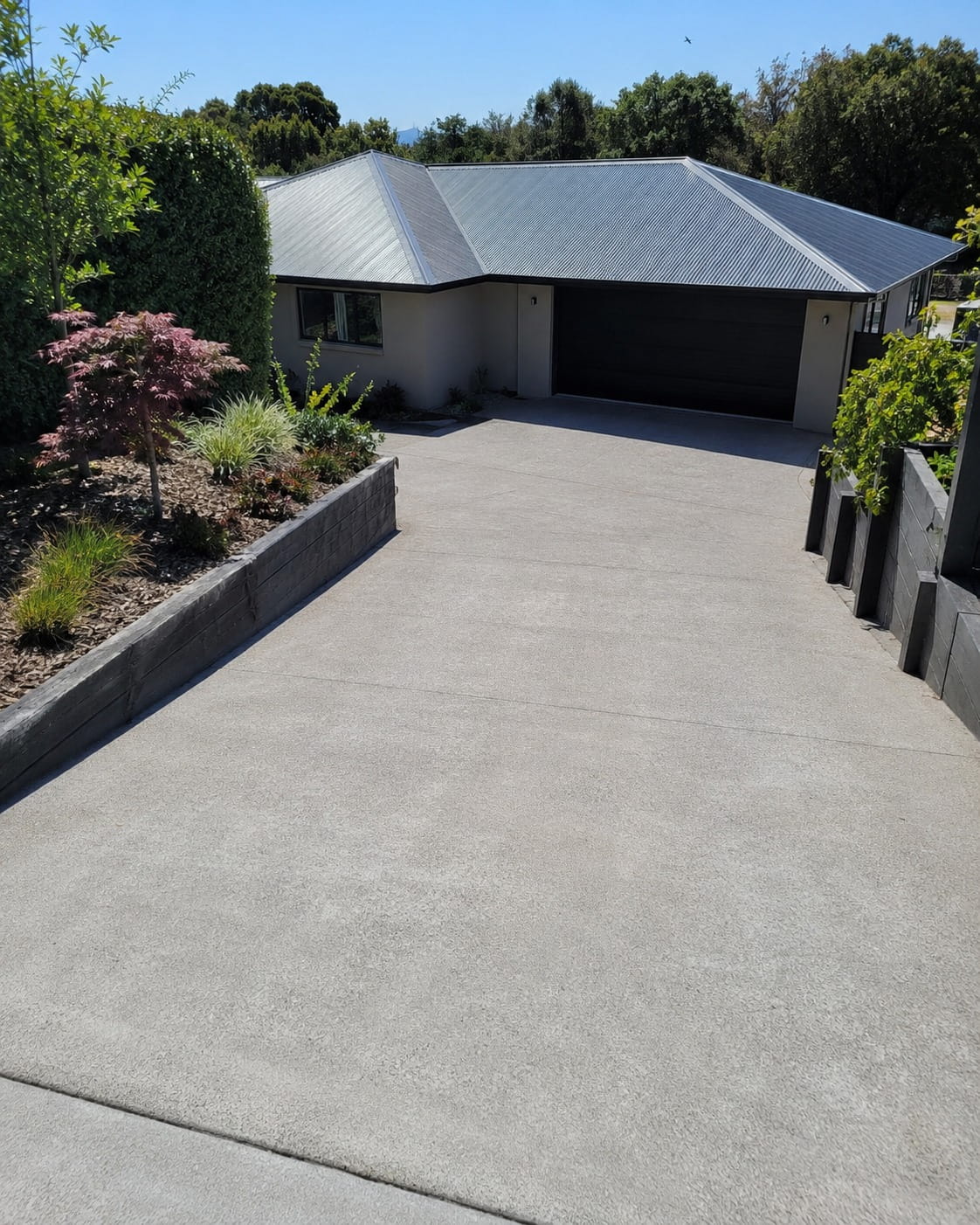
Resurfacing materials range from basic concrete overlay mixes to decorative options like exposed aggregate, coloured concrete, or textured coatings. The result is a fresh, like-new surface that can add significant kerb appeal to your property.
However, resurfacing only works when the underlying concrete slab is structurally sound. It's a cosmetic and protective fix — not a solution to deep structural problems.
How Much Does It Cost to Resurface a Concrete Driveway in NZ?
In Christchurch and across New Zealand, the cost of concrete driveway resurfacing depends on the size of the area, the product used, and the condition of the existing surface. Typical price ranges:
| Option | Price |
|---|---|
| Basic concrete overlay: | $30 – $55 per square metre |
| Decorative or exposed aggregate overlay: | $60 – $110 per square metre |
| Coloured or stencilled resurfacing: | $70 – $120 per square metre |
| Surface preparation and repair (before resurfacing): | $500 – $1,500 depending on extent of damage |
For a typical Christchurch residential driveway of 40–60 square metres, expect to pay $1,200 to $3,300 for a standard resurface, or up to $7,200 for a premium decorative finish.
Always compare these costs against full replacement. For a driveway near the end of its useful life, resurfacing may not deliver good value if it needs replacing in the next few years anyway.
When Does Resurfacing Make Sense?
Resurfacing is a good option in specific circumstances. It works well when:
The existing slab is structurally sound with no deep cracking or movement
The surface is worn, stained, pitted, or has minor hairline cracking
You want to improve the appearance without the cost of full replacement
The driveway is less than 20 years old and has been reasonably maintained
You want a decorative finish (coloured, exposed aggregate) at a lower cost than full replacement
Resurfacing is not appropriate when the concrete has major structural cracks (especially moving or expanding cracks), when sections have sunk or heaved due to ground movement, when there is widespread spalling deeper than the surface layer, or when the sub-base has failed.
Concrete Driveway Repair vs Resurfacing: What Is the Difference?
It's easy to confuse repair with resurfacing, but they're quite different in scope and cost.
Concrete repair targets specific damage — cracks, chips, holes, or spalled sections. It's a targeted fix rather than a surface-wide treatment. Common concrete repair work includes crack injection and sealing, grinding down raised edges or control joints, filling potholes or depressions with concrete repair mortar, and resetting or re-pointing expansion joints.
Resurfacing, by contrast, is a full-surface treatment that covers the entire driveway. Think of repair as fixing specific faults, and resurfacing as renewing the entire surface.
Often, the right approach is a combination: repair the specific damage first, then resurface to unify the surface and protect against future wear. Your contractor should assess the driveway and recommend the appropriate approach.
When Is Full Replacement Necessary?
In some cases, there's no getting around a full replacement. This is typically when:
The slab has moved, settled, or heaved due to sub-base failure or ground issues (particularly relevant in some Christchurch areas with soft or earthquake-affected soils)
Cracking is deep, widespread, and structural — not just surface-level
The slab is so old or poorly constructed that resurfacing would only be a short-term fix
Tree roots have undermined the slab
The original concrete was laid too thin or without proper reinforcement
Full replacement costs more upfront — typically $100 – $160 per square metre in Christchurch, including demolition and disposal of the old concrete — but it's the only long-term solution when the structure has failed.
Factors That Affect Resurfacing Cost in Christchurch
Several factors influence what you'll pay for concrete driveway resurfacing in Christchurch:
Surface preparation: The existing driveway must be thoroughly cleaned, any cracks repaired, and the surface prepared to ensure the overlay bonds correctly. Poor preparation is the number one cause of resurfacing failure. This step adds to cost but is non-negotiable.
Product type: Basic grey overlay is the most affordable. Exposed aggregate, coloured, or stencilled finishes cost more because of the additional materials and skill involved.
Driveway size and complexity: Larger and more unusually shaped driveways take longer. Steps, edging details, and curved sections add labour time.
Condition of existing concrete: If significant crack repair or grinding is required before resurfacing can begin, expect higher costs.
Access: If your property has restricted access, machinery may not reach the work area easily, increasing labour costs.
DIY Concrete Driveway Resurfacing: Is It Worth It?
DIY concrete resurfacing kits are available in NZ, and for very small areas or as a touch-up measure, they can work adequately. However, for an entire driveway, professional resurfacing delivers far better results.
The risks of DIY resurfacing include:
Poor adhesion if surface preparation is inadequate — the overlay peels or delaminates within months
Inconsistent finish due to uneven mixing or application
Premature cracking if the overlay is applied too thin
No warranty or comeback if the job fails
For a surface you walk and drive on every day, professional resurfacing is the smarter investment. A quality concrete contractor in Christchurch will use the right products, prepare the surface correctly, and stand behind their work.
Choosing the Right Concrete Contractor for Resurfacing in Christchurch
When selecting a contractor for concrete driveway resurfacing in Christchurch, look for:
Specific resurfacing experience: Not every concreter does overlays. Ask whether they have done similar work and ask to see photos or references.
Product knowledge: Good contractors can explain which resurfacing product they're using and why it's appropriate for your driveway's condition and your goals.
Surface preparation process: Ask specifically how they'll prepare the surface. If they can't explain this clearly, that's a warning sign.
Written quote and warranty: Get a detailed written quote that specifies the scope, materials, and any warranty on workmanship.
Local reputation: Christchurch is a connected community. Check Google Reviews and ask around — a contractor who has done quality work locally will have a trail of satisfied customers.
How Long Does Resurfaced Concrete Last?
A professionally resurfaced concrete driveway in Christchurch can last 10–15 years or more with reasonable maintenance. The key variables are the quality of the resurfacing product, the thoroughness of the surface preparation, and how well you maintain it afterwards.
To extend the life of a resurfaced driveway:
Seal the surface every 2–3 years with a quality concrete sealer
Clean off oil, grease, and chemical spills promptly
Avoid using sharp-edged tools (like spades or metal snow shovels) that can chip the overlay
Don't allow heavy vehicles to park on the driveway unless it was designed for that load
Resurfacing done correctly is a sound investment that adds to your home's appearance and protects the slab underneath from further deterioration.